The problem every group cruise has
Two cabins, four adults, everyone packed "the essentials." You board and realize you have four power strips, three portable chargers, zero formal shoes that fit the dress code, and somehow nobody brought the seasickness patches you all specifically agreed on. The problem is not that anyone is disorganized. It is that four people packed four mental lists across four apps, and none of them spoke to each other.
A cruise is one of the few vacations where forgetting something cannot be fixed with a 2am convenience-store run. The onboard alternative is extortionate — a $14 travel-size sunscreen, a $25 phone charger that may not have the right connector — or nonexistent, which is the problem with specific medications, reef-safe SPF, and correct-voltage adapters.
Why Plan's shared list model works
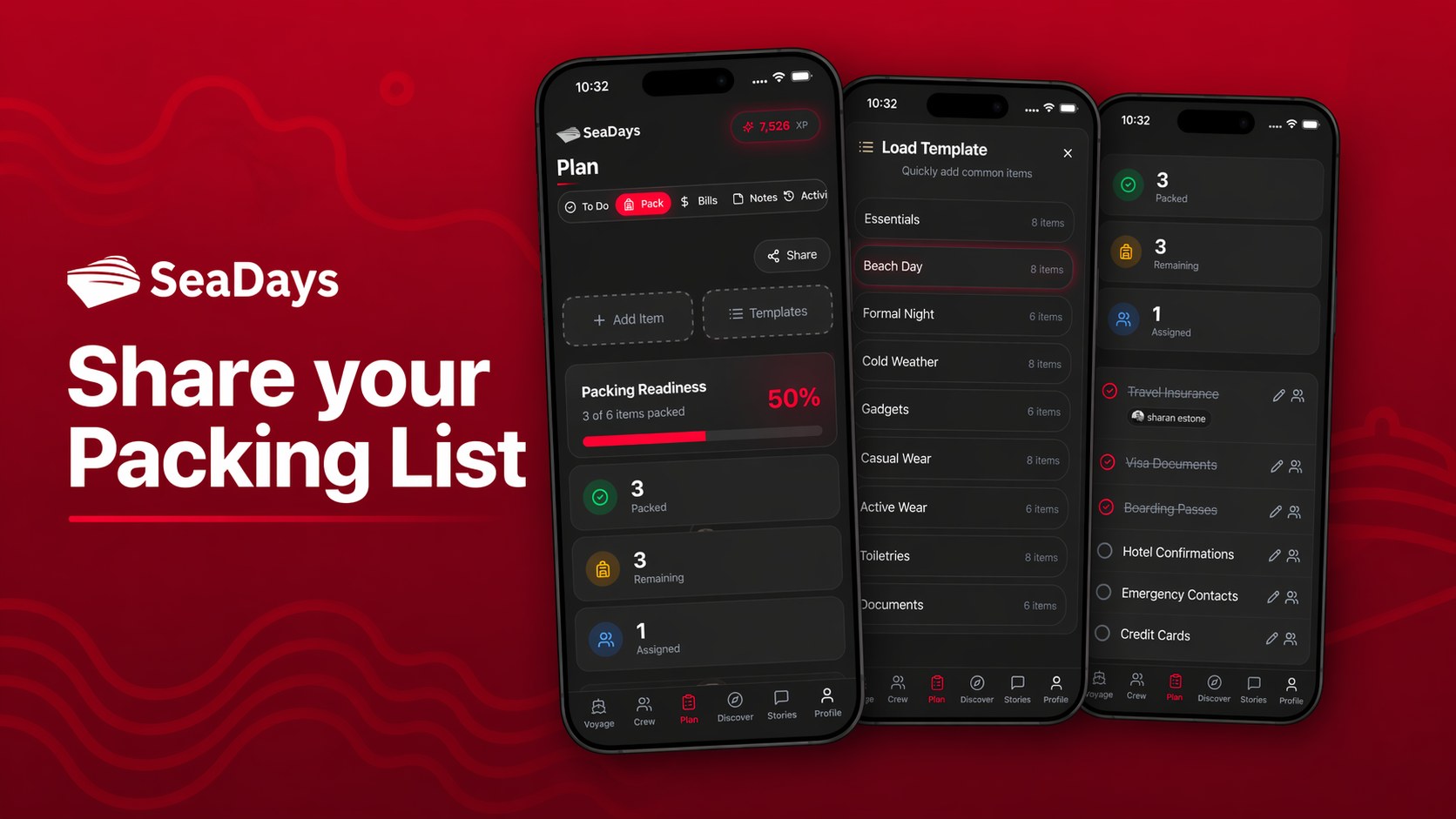
Plan inside SeaDays treats the packing list as one shared document rather than a chat message. Category templates seed the first draft, per-person assignment eliminates the "I thought you had it" gap, and real-time updates mean a check from one phone shows up on everyone else's. You stop debugging the list and start using it.
The templates are cruise-specific, not generic travel lists. They include Essentials (passport, tickets, medications, toiletries kit, sunscreen), Beach Day (swimsuit, reef-safe SPF, waterproof phone case, cover-up), Formal Night (evening wear, dress shoes, accessories, tie/bowtie), Cold Weather (for Alaska, Norway, Baltic), Gadgets (non-surge power strip, portable battery, binoculars), Toiletries, Documents, Casual Wear, and Active Wear.
Step-by-step: building the list in Plan
Open Plan and switch to the Packing sub-tab. Tap Add Template and pick three or four that match your itinerary — adding every template creates 80+ items and the group disengages. For a Caribbean sailing, Essentials + Beach Day + Formal Night + Gadgets is usually the right mix. Add custom items for anything the templates do not cover: specific prescriptions, a collapsible dry bag, a particular formal-night outfit.
Invite your crew through Share. Plan generates a link that pulls each person into the same Plan workspace. For each item, tap Assign and choose who is responsible. Use "Cabin 1" or "Cabin 2" labels instead of individual names when gear is cabin-shared — power strips, extension cords, first-aid kits. Create a "One Per Group" category for shared items like a beach umbrella or travel laundry line, and assign each item to exactly one person so nobody doubles up.
As people pack, they check off items. Unchecked items assigned to other people do not clutter your view — you see your list filtered to your responsibilities. On departure day, the group glances at a single progress bar instead of reading a 400-message chat.
Advanced tips most groups miss
Lock in formal-night outfits early. Add the specific outfit ("navy suit + loafers" or "black dress + heels") as a custom item rather than a generic "formal wear." Specificity kills the "I thought you were bringing the tie" pattern. If you are flying with checked bags only, add a "Keep in carry-on" tag for medications, passports, a spare outfit, and chargers — items that must survive a lost checked bag.
Use the item notes to record quiet constraints, like "must be non-surge protected — ships confiscate surge strips" or "TSA 3-1-1 compliant." Past-you writing notes for future-you prevents the slow embarrassment of having a power strip taken at the terminal.
Pair the packing list with Plan's Pre-Cruise Essentials and Before Departure to-do templates. The packing list covers things that go in the suitcase; the to-do templates cover the "complete online check-in," "notify bank of travel," "arrange pet care" tasks that have nothing to do with objects but still need to happen.
Money-saving math on forgotten items
Forgotten items cost real money, and the markup curve on most cruises looks like this: sunscreen travel size onboard runs $12–$18 versus $6 packed — save about $10. Seasickness tablets onboard are $9–$12 versus $4 at home — save about $6. A phone charger onboard is $25–$40 versus $12 packed — save about $20. A European travel adapter onboard is $20–$30 versus $8 at home — save about $15.
A family of four forgetting three of these loses $50–$80 in the first 48 hours — money that was supposed to go toward specialty dining or excursions. The bigger hit comes from buying-in-port: a forgotten swimsuit bought at a cruise-terminal shop in St. Thomas can easily run $60–$90 for a basic piece because the target customer is a desperate cruiser, not a local shopper. Plan's assignment model makes this nearly impossible because nothing in Essentials or Beach Day gets skipped.
On the duplicate side, a group of six with no shared list typically buys three power strips, three Bluetooth speakers, and multiple overlapping first-aid kits — roughly $80–$120 of redundant gear that could have been one item each.
Real group-cruise scenario
A group of six books a 7-night Bahamas cruise with two balcony cabins and a shared excursion in Nassau. The weekend before sailing, they set up Plan. Using templates, they load Essentials + Beach Day + Formal Night + Gadgets = 47 items. Cabin 1 takes the power strip, first-aid kit, and group sunscreen. Cabin 2 takes the Bluetooth speaker, portable charger, and reef-safe SPF. Custom items: prescription medications per person, dinner reservation confirmation assigned to the trip organizer, cash for tips assigned to the person doing airport transport.
Boarding day: they have one power strip instead of three, one speaker instead of two, and the only thing anyone forgot is a single pack of gum. Money saved versus the "everyone pack everything" approach: roughly $110 in duplicate items not bought, plus one $18 onboard first-aid kit avoided. Total: about $128 saved on a single sailing.
Mistakes to avoid
Do not build the list the day before the cruise — you need four to five days so people can order missing items online. Do not leave items unassigned; an unassigned item is a forgotten item. Do not over-template (every category applied creates noise and erodes trust). Do not keep the Cold Weather template on a Caribbean sailing — delete what does not apply. Do not mix packing items with to-do items; Plan has separate tabs for each and mixing them buries important tasks under sock counts.
Common questions
Q: Can I share the list with someone who does not use SeaDays yet?
A: Invitees create an account through the share link; the list is the reason they sign up.
Q: What if one person likes paper lists?
A: Export or screenshot the list the night before. The source of truth stays in Plan.
Q: Can items be reassigned mid-trip?
A: Yes. Reassignment is useful for return-trip packing when responsibilities shift.
Q: Does the list persist between cruises?
A: Each voyage has its own list. You can duplicate a previous voyage's list as a starting point.
Q: Does Plan sync offline?
A: Yes — checks made offline queue and sync when connectivity returns. Useful at the pier when Wi-Fi is unstable.
Related guides

See which ships have cabin-power restrictions (some confiscate surge strips). Check the port directory for climate and dress-code hints that shape the packing templates you need. Browse the planning library for related group-travel pieces, and keep the shared list, to-dos, and budget together in SeaDays.